The 3 AM Breakdown That Cost €12,000 — And How We Stopped It Happening Again
Laszlo Habensusz
Author
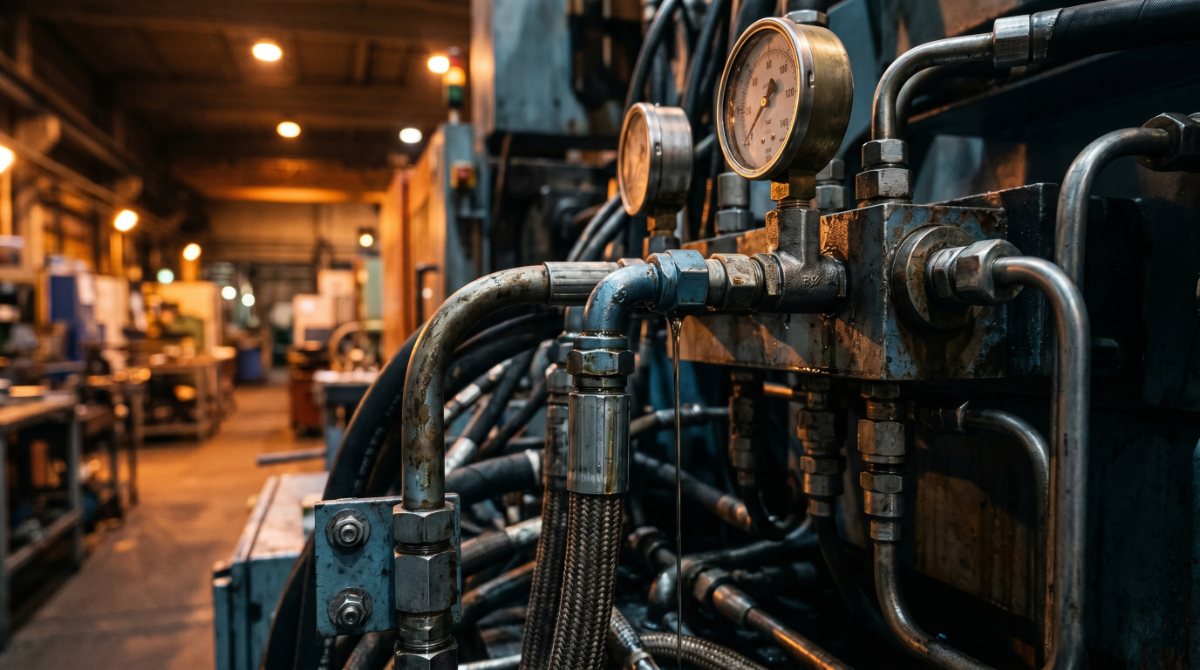
It was 3:14 AM on a Tuesday when Márton’s phone rang. His production manager’s voice was flat: “The big moulding machine is down. Hydraulic failure. We’re stopped.” By the time the sun came up, it was clear this wasn’t a quick fix. The repair bill — emergency engineer callout, replacement hydraulic pump assembly, and two days of lost shifts — came to €12,400. Delayed orders and expedite fees added another €8,000.
Márton runs a small injection moulding shop with eleven employees and five machines. His team produces plastic housings for automotive sub-suppliers — a market where a missed delivery window has real consequences. He’d been in the business for eighteen years. He thought he knew his machines.
What Actually Failed — and Why
The failure itself was straightforward: the hydraulic pump on his flagship 250-tonne machine had seized after running low on hydraulic oil. The oil level had dropped gradually over several weeks due to a slow weep from a fitting on the return line. It was a known issue — his senior technician had noticed it and written it down. In a notebook that sat on a shelf in the maintenance room.
When the investigation was done, the timeline was damning:
- 6 weeks earlier: Technician notes “slow leak, return line fitting, monitor” in paper log.
- 3 weeks earlier: Different technician on shift, no knowledge of the note, no oil top-up.
- 2 weeks earlier: Oil level drops below safe operating range — no alarm, no check scheduled.
- Tuesday, 3:14 AM: Pump seizes. Machine down.
The failure wasn’t mechanical bad luck. It was a system failure. The maintenance system — a spiral-bound notebook — had no way to flag an open observation to the next person who walked into that room.
The Paper Notebook Problem
If you run a small manufacturing operation, you probably recognise this. The maintenance log is kept because someone once said it was important. It gets written in inconsistently. Nobody reads it before a shift. There is no escalation. There is no connection between what was observed last Tuesday and what gets checked this Thursday.
Paper logs have three fatal flaws in a multi-person, multi-shift environment:
- No visibility: An entry exists only if you physically open the book and read it.
- No follow-up: There is no mechanism to check whether an open issue was ever resolved.
- No pattern recognition: You cannot see that the same machine has had four small observations in eight weeks without reading every single page.
Márton’s pump failure ticked all three boxes.
What Changed: Structured Maintenance in iTenance
After the breakdown, Márton’s team moved their maintenance operations into iTenance. The changes were straightforward, but the impact was immediate.
1. Recurring Work Orders Tied to Operating Hours
For each critical machine, they created a recurring work order that fires every 200 operating hours: a hydraulic system inspection. The checklist covers oil level, visual inspection of all fittings, pressure gauge reading, and filter condition. It takes twelve minutes. It cannot be completed without checking each item. The result is logged against the machine record — not in a notebook — and is visible to every technician from any device.
Because iTenance tracks operating hours against the machine record, the work order is triggered automatically when the threshold is reached — regardless of which shift is running. The assigned technician receives a notification on their mobile. The work order stays open and unresolved until it is completed and signed off.
2. Open Observations Become Work Orders Immediately
The second change was a rule: instead of writing “slow leak, return line fitting, monitor” in a notebook, technicians now log that observation directly as a work order in iTenance. The work order stays open and visible to everyone until it is resolved. It appears on the machine’s activity dashboard. A supervisor can see every open issue across the entire machine park in a single view.
The fitting weep that triggered the €12,000 breakdown? Under the new system, it would have been a low-priority work order, visible to every technician, with a completion deadline assigned. It would not have been forgotten between shifts.
3. The Machine History Tells the Story
What Márton finds most valuable six months in is the machine history view. Every completed work order, every observation, every repair — all linked to the machine record in chronological order. When a technician opens the machine page in iTenance before starting a shift, they see that the last hydraulic check was completed 143 hours ago, there are no open observations, and the next scheduled maintenance is due in 57 hours.
That information was always in the notebook. Now it is actually accessible.
The Results: Six Months On
In the six months since implementing iTenance, the shop has had zero unplanned machine stoppages due to maintenance failures. That is not because the machines became more reliable — it is because the team now catches issues before they become failures.
“The €12,000 breakdown paid for the system ten times over. But the real value is not the money — it is that I sleep better. I know that if something is wrong with a machine, someone has logged it and someone is dealing with it.”
— Márton, Production Manager
The recurring work order system has surfaced something else: real data on which machines need the most attention. Three months in, a pattern on a second machine — consistent observations about unusual vibration during a specific operation — led to a planned bearing replacement during a scheduled shutdown. The bearing cost €340. The unplanned failure it would have become would have cost considerably more.
Starting Small: What You Actually Need to Set This Up
You do not need to digitise your entire maintenance operation overnight. Márton started with just three things:
- One recurring work order per critical machine covering hydraulic check, lubrication points, and belt condition.
- A rule: any observation that would previously go in the notebook goes into iTenance as a work order instead.
- A weekly five-minute review of open work orders by the shift supervisor.
That is the foundation. The machine history builds itself. The patterns emerge. The 3 AM phone calls become less likely.
If you are running a machine park on paper logs and gut feel, the question is not whether a breakdown is coming. It is whether you will see it coming in time.
Tags
Laszlo Habensusz
Author
Related Posts
Why Can't I Tell Which Plant Is Really Struggling with Downtime?
Sep 21, 2026 · 6 min read

Why Do Our New Maintenance Technicians Take So Long to Get Up to Speed?
Sep 14, 2026 · 8 min read
Machine Down: Why Do We Always Find Out We're Out of Spares Mid-Repair?
Aug 16, 2026 · 7 min read
Ready to optimize your maintenance?
Start your 30-day free trial today. No credit card required, no hidden fees.