The Sticky Note That Shut Down a Production Line — And What We Do Instead
Laszlo Habensusz
Szerző
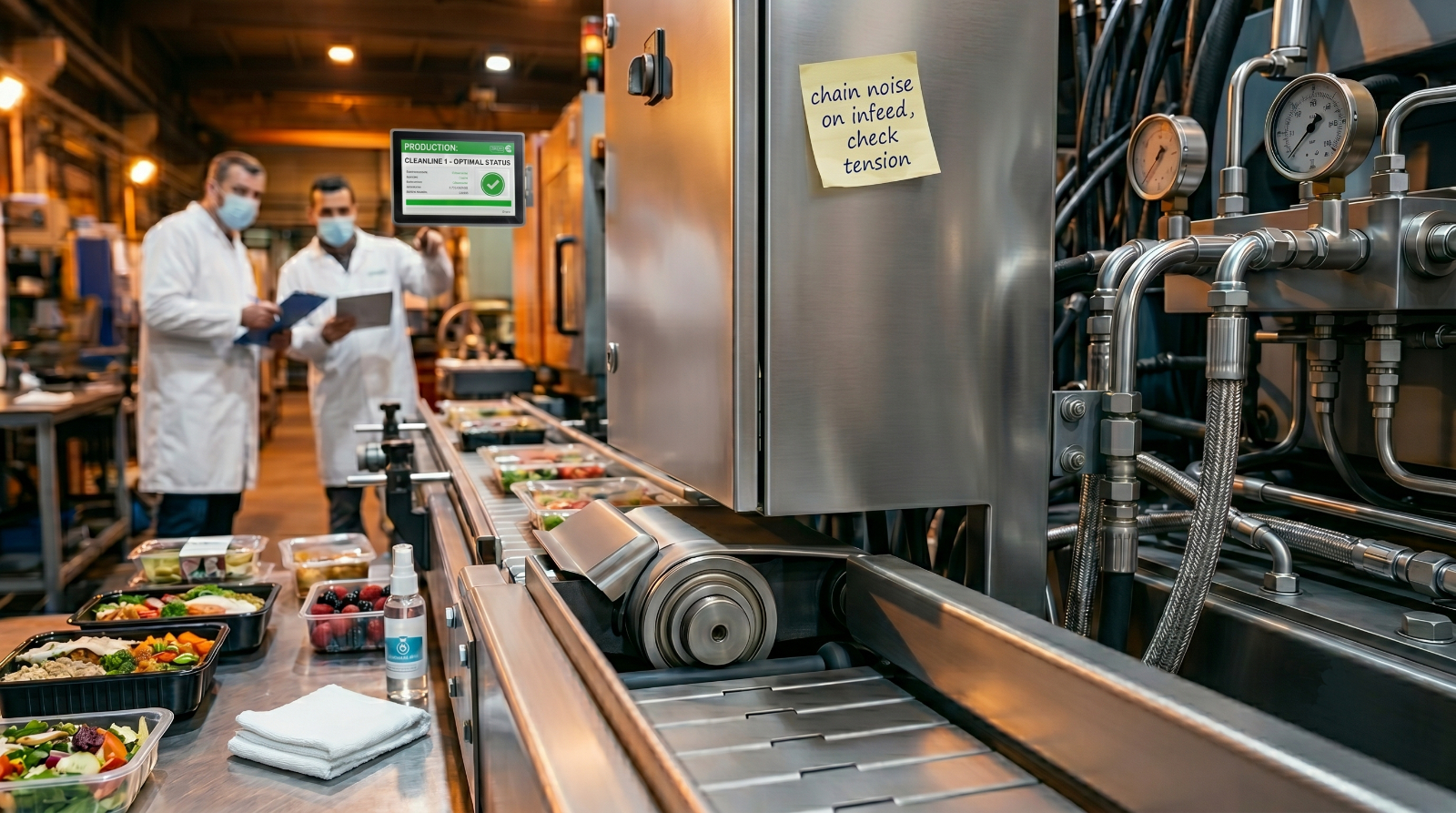
It was a Friday afternoon in October when the call came through to the maintenance manager at a food packaging plant. The main infeed conveyor had stopped. In the middle of a production run. Three weeks before Christmas — their peak season. The diagnosis came quickly: the drive chain had snapped after running in a degraded state for weeks. The repair took six hours. The lost production: 4,200 packs, €11,000 in missed output, and a very difficult conversation with a major retail customer.
The machine had been showing warning signs for at least two weeks. The problem was that those warning signs had been written on a sticky note — and the sticky note was gone.
How a Conveyor Failure Starts Three Weeks Before It Happens
The infeed conveyor ran across three shifts: a day crew, an afternoon crew, and a night team responsible for cleaning and light maintenance. Three different sets of operators, three different supervisors, one logbook that sat at the supervisor's station and was rarely read before a shift started.
Here is the timeline, reconstructed from operator interviews after the failure:
- Week 1, Tuesday night shift: Night technician notices the drive chain making an intermittent clicking sound under load. Writes 'chain noise on infeed, check tension' on a sticky note and leaves it for the day supervisor.
- Week 1, Wednesday day shift: Sticky note not found. No check performed.
- Week 2, Monday afternoon shift: Afternoon operator notices visible sag developing on the chain return run. Makes a verbal mention to the outgoing day supervisor. No written record created.
- Week 2, Wednesday: Scheduled weekly maintenance inspection performed — but the conveyor is running at the time and the clicking sound is intermittent. Nothing noted.
- Week 3, Friday afternoon: Chain fails under load during a production run. Line stops.
The warning signs were there. Multiple people noticed them. None of the observations made it into a system where they could accumulate, be seen by the next person, or trigger action.
The Multi-Shift Communication Gap
Shift handover is one of the most consistently dangerous moments in continuous manufacturing. It is the gap between who knows something and who needs to act on it. In most small and medium manufacturing plants, that handover is managed by:
- A brief verbal conversation between outgoing and incoming supervisors
- A physical logbook that may or may not be read before operations resume
- Sticky notes, whiteboard entries, or informal messages
None of these mechanisms are reliable across multiple shifts and multiple days. Verbal handovers are forgotten within hours. Logbooks are not always read before a shift starts. Sticky notes fall off surfaces, get covered, or are cleared away by the cleaning crew.
The result is that observations made on one shift effectively disappear at the shift boundary. Each incoming team starts with an incomplete picture of the machine's current condition — and no way to know what the team before them noticed.
What Changed: Digital Work Orders as the Handover Protocol
After the conveyor failure, the plant's maintenance manager implemented a single new rule: any observation about machine condition must be logged as a work order in iTenance before the technician ends their shift. Not in the logbook. Not on a note. In the system.
The practical change for operators was small. They got access to iTenance on mobile devices, and logging an observation — selecting the machine, describing the issue, setting a priority — takes under two minutes standing next to the equipment. The systemic change was significant.
Every Observation Is Visible Across All Shifts
When the incoming shift supervisor opens iTenance at the start of their shift, they see all open work orders for the machines on their line. If a night technician logged 'chain noise on infeed, check tension' as a low-priority work order, it is there. It is assigned. It has a creation timestamp and the logging technician's name. It stays open and visible to everyone until someone resolves it and closes it with a completion note.
The sticky note problem disappears because the observation is in a system that persists across shift boundaries — not on a physical surface that can be lost, covered, or thrown away.
Repeated Observations on the Same Asset Trigger an Alert
One of the most valuable behaviours the team found was how iTenance handles repeated observations on the same machine. When an asset accumulates multiple open work orders within a short period — even from different technicians on different shifts — the system flags it as a pattern requiring attention. The maintenance manager receives a notification: 'Asset: Infeed Conveyor Line 2 — 3 open observations in 14 days.'
That flag is the mechanism that turns three separate noise observations into a single investigation — even when those observations came from three different people who never spoke to each other. Before iTenance, those observations were invisible to each other, filed across different shifts or not filed at all. In the system, they compound into a signal that is hard to ignore.
In the case of the conveyor that failed, the iTenance pattern alert would have fired on day ten of the two-week window. The repair at that point: chain re-tensioning or a planned chain replacement during a short scheduled stoppage. Cost: under €200 and two hours. Instead of €11,000 and a retail customer complaint.
Mobile Logging from the Machine — Not the Supervisor's Desk
A key enabler was the ability to log from a mobile phone, standing next to the machine, in the moment of observation. This is different from expecting a technician to remember the detail until the end of shift, then walk to the supervisor's station, find the logbook, and write a legible entry in the hope that the next shift will read it.
Friction matters. If logging an observation takes more than two minutes or requires a trip to a fixed terminal, operators will do it for serious issues and skip it for minor ones. Minor observations are exactly the ones that accumulate silently into serious failures.
Shift Handover as a Five-Minute Dashboard Review
The maintenance manager introduced a new handover protocol alongside the digital logging: at each shift changeover, the incoming and outgoing supervisors spend five minutes reviewing open work orders together in iTenance. It takes the place of the informal verbal briefing — not because conversation is not valuable, but because both people are now looking at the same structured, complete data rather than relying on one person's memory.
The five-minute review covers three things:
- Any new observations logged during the shift just ending
- Any work orders that are due or overdue for resolution
- Any machines that have received a pattern flag in the last 14 days
It is a structural change to the handover, not just a new app. The tool makes the structural change possible and sustainable.
The Results: One Peak Season Later
The following October — one year after the conveyor failure — the plant ran through their peak production season without a single unplanned stoppage. The maintenance team closed 34 work orders during the season, all of them either routine scheduled tasks or early-stage observations that were resolved before they became production failures.
'The hardest part was convincing operators that logging a small observation was worth their time. Once they saw that observations they logged actually got acted on — rather than disappearing into a notebook — the culture changed faster than any training session could have managed.'
— Maintenance Manager, Food Packaging Plant
Three pattern-flag notifications were generated during the season. Two led to planned preventive interventions during scheduled micro-stoppages. The third was investigated and found to be normal operating noise under a specific load condition — the investigation took one hour and closed the question permanently.
If You Run Multiple Shifts, You Already Have This Problem
Shift handover information loss is not unique to small plants. It happens across operations of every size. What distinguishes the plants that manage it well is not headcount or equipment sophistication — it is whether they have a system that makes observations persistent and visible across the shift boundary.
The minimum viable version of this is straightforward:
- Give technicians the ability to log observations digitally from the floor, ideally from their mobile device.
- Make all open observations visible to the incoming shift before they start work — not buried in a logbook but on a live dashboard.
- Treat any machine with three or more unresolved observations within 14 days as requiring a maintenance review, regardless of individual priority level.
That is the system that turns the sticky note into a work order — and the work order into a repair before the chain snaps.
The conveyor that stopped production for six hours on a Friday afternoon gave plenty of warning. It just needed somewhere to be heard.
Címkék
Laszlo Habensusz
Szerző
Kapcsolódó bejegyzések
Why Can't I Tell Which Plant Is Really Struggling with Downtime?
Sep 21, 2026 · 6 min read
Why Do Our New Maintenance Technicians Take So Long to Get Up to Speed?
Sep 14, 2026 · 8 min read
Machine Down: Why Do We Always Find Out We're Out of Spares Mid-Repair?
Aug 16, 2026 · 7 min read
Készen áll a karbantartás optimalizálására?
Indítsa el 30 napos ingyenes próbaidőszakát még ma. Nincs szükség hitelkártyára, nincsenek rejtett díjak.