How AI Predicts Equipment Failures Before They Cost You Thousands
Laszlo Habensusz
Szerző
The €14,000 Wake-Up Call Nobody Wants
It starts with a sound nobody can quite explain. Or worse — no sound at all, just a production line that goes quiet.
For automotive manufacturers, unplanned downtime is the enemy. A single stalled production line can cost tens of thousands of euros in a matter of hours — in lost output, emergency labour, expedited parts shipping, and missed delivery windows to OEM customers who simply don't accept excuses.
The frustrating part? Most of these failures don't come out of nowhere. The warning signs were always there. The problem is that humans cannot watch every machine, every shift, every day. AI can.
The Welding Robot That Almost Took Down the Line
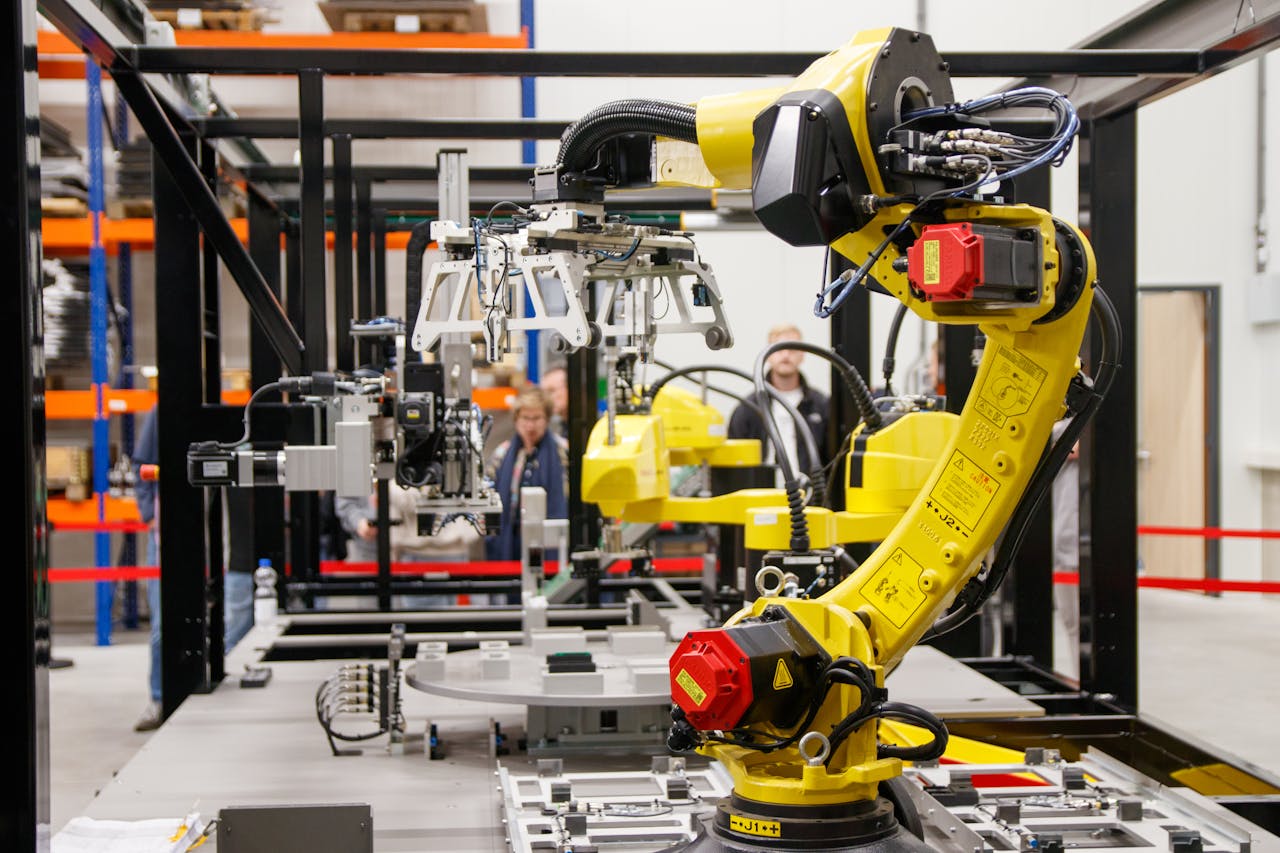
Picture a busy automotive body shop. Dozens of robotic welding arms cycle thousands of times a day, joining panels with millimetre precision. To the human eye, they look identical from one shift to the next.
But one of those robots starts drawing slightly more electrical current per cycle. Not dramatically — a 4% increase over three weeks. No alarm trips. No technician notices. Quality control sees nothing unusual.
What's actually happening: the servo motor driving the robot's primary axis is beginning to degrade. Bearing wear is increasing internal resistance. The robot is compensating — working harder to do the same job — and slowly losing the fight.
Without AI: The motor fails on a Tuesday morning at 6:15 AM. The line stops. The replacement motor is not in stock. Emergency procurement takes 36 hours. With labour, expedited delivery, and lost production, the bill lands at €14,000 — before accounting for the knock-on effect on the delivery schedule.
With Itenance: The AI detects the current draw trend during routine data analysis. Three weeks before the motor fails, a planned work order is automatically generated. The maintenance team schedules the replacement during the upcoming Saturday maintenance window. A new motor is pre-ordered at standard cost. The swap takes two hours. Total cost: €1,900. The line never stops.
The difference between those two outcomes is not luck. It is data, analysed at a speed and consistency that no human team can match.
Why Traditional Maintenance Schedules Are Not Enough
Most maintenance teams operate in one of two modes:
Reactive maintenance — fix it when it breaks. Fast and cheap in the short term, catastrophic in the long term. This is how you end up with that €14,000 Tuesday.
Preventive maintenance — service equipment on a fixed calendar schedule, whether it needs it or not. Better, but deeply imprecise. A robot running two shifts a day wears very differently than one running four. A calendar does not know the difference.
What the automotive industry increasingly needs — and what AI enables — is predictive maintenance: service equipment based on its actual condition, not an arbitrary schedule.
What the AI Is Actually Looking For
Itenance monitors equipment data across multiple dimensions, looking for patterns that signal degrading performance. In a manufacturing environment, this includes:
- Power & current draw — A motor working harder than it should is always a signal worth investigating. The AI knows what "normal" looks like for each specific machine and flags deviations early.
- Cycle time drift — A robotic arm that takes 2.3 seconds per cycle today but 2.7 seconds three months from now is telling you something. Without AI tracking that trend, you would never notice until throughput drops.
- Vibration signatures — Connected sensors feed vibration data into the system. Bearing failure, gear wear, and shaft misalignment all have distinct vibration fingerprints that appear long before audible symptoms.
- Temperature patterns — Overheating components are a classic early warning. AI distinguishes between ambient temperature variation and genuine thermal stress.
- Error log frequency — A PLC that throws a recoverable fault once a week is a different machine than one that started throwing the same fault twice a day last month. Itenance tracks the trend, not just the event.
None of these signals, in isolation, would necessarily trigger a manual alarm. It is the combination of patterns, analysed continuously across the entire equipment fleet, that makes AI-powered predictive maintenance so effective.
The Numbers That Make the Case
The automotive sector operates on tight margins. Here is how the costs typically break down for a mid-sized plant:
| Scenario | Reactive | Predictive (AI) |
|---|---|---|
| Servo motor failure (welding robot) | €14,000 | €1,900 |
| Conveyor drive belt failure | €8,500 | €900 |
| Paint booth exhaust fan failure | €22,000 | €2,400 |
| Avg. unplanned downtime incidents / year | 18–24 | 3–5 |
Plants that shift from reactive to AI-driven predictive maintenance typically report a 60–75% reduction in unplanned downtime within the first 12 months. For a line producing 200 vehicles per day at a margin of €400 per vehicle, even recovering three lost production days per year is worth €240,000. The CMMS subscription pays for itself before the end of the first quarter.
Getting Started Is Not as Complicated as You Think
One of the most common objections maintenance managers raise is complexity. "We'd need to retrofit all our sensors." "Our older machines don't output data." "We don't have an IT team for this."
Itenance is built to work with the infrastructure automotive manufacturers already have. Modern CNC machines, welding robots, and conveyor systems already generate enormous amounts of operational data — most of it currently unused. Itenance connects to that data, begins establishing baselines, and starts detecting anomalies within weeks of deployment.
You do not need to replace your equipment. You need to start listening to what it is already telling you.
A Practical First Step: Audit Your Last 12 Months
If you manage maintenance at an automotive plant — whether a Tier 1 supplier, a body shop, or a paint and assembly facility — the single most valuable thing you can do this month is audit your recent equipment failures. Ask yourself:
- How many of last year's failures came with absolutely zero warning?
- How many happened to equipment that was "just serviced" on its fixed schedule?
- What percentage of your maintenance budget went to emergency repairs vs. planned work?
- How many production hours did you lose to stoppages that weren't on any schedule?
If the emergency column is significant, you are leaving money on the table — and your production schedule at risk.
Conclusion: The Robot Knew. Now You Can Too.
The welding robot in our example did not fail without warning. It sent signals for three weeks. The problem was that nobody — and no system — was watching closely enough to hear them.
Itenance was built to change exactly that. By combining real-time equipment monitoring, AI-driven pattern recognition, and automated work order management, it turns the invisible warning signs of equipment degradation into planned, manageable maintenance events.
Before the line stops. Before the emergency call. Before the €14,000 bill.
Ready to give your maintenance team an AI edge?
Start your free trial at itenance.com and see what your equipment has been trying to tell you.
Itenance is an AI-first Computerised Maintenance Management System (CMMS) designed for modern industrial operations. From predictive maintenance to automated work orders, it helps maintenance teams do more with less — and keep production lines running.
Laszlo Habensusz
Szerző
Kapcsolódó bejegyzések
Why Can't I Tell Which Plant Is Really Struggling with Downtime?
Sep 21, 2026 · 6 min read
Why Do Our New Maintenance Technicians Take So Long to Get Up to Speed?
Sep 14, 2026 · 8 min read
Machine Down: Why Do We Always Find Out We're Out of Spares Mid-Repair?
Aug 16, 2026 · 7 min read
Készen áll a karbantartás optimalizálására?
Indítsa el 30 napos ingyenes próbaidőszakát még ma. Nincs szükség hitelkártyára, nincsenek rejtett díjak.