Stop Guessing When to Service Your Machines — Let AI Read the Data
Laszlo Habensusz
Szerző
The Problem With the Calendar
Every maintenance manager knows the routine. Every 90 days, every 500 hours, every 10,000 KMs — the schedule says service it, so you service it. It feels disciplined. It feels safe. It feels like the right thing to do.
But here is the uncomfortable truth: a fixed maintenance schedule treats every machine as if it lives the same life. It doesn't.
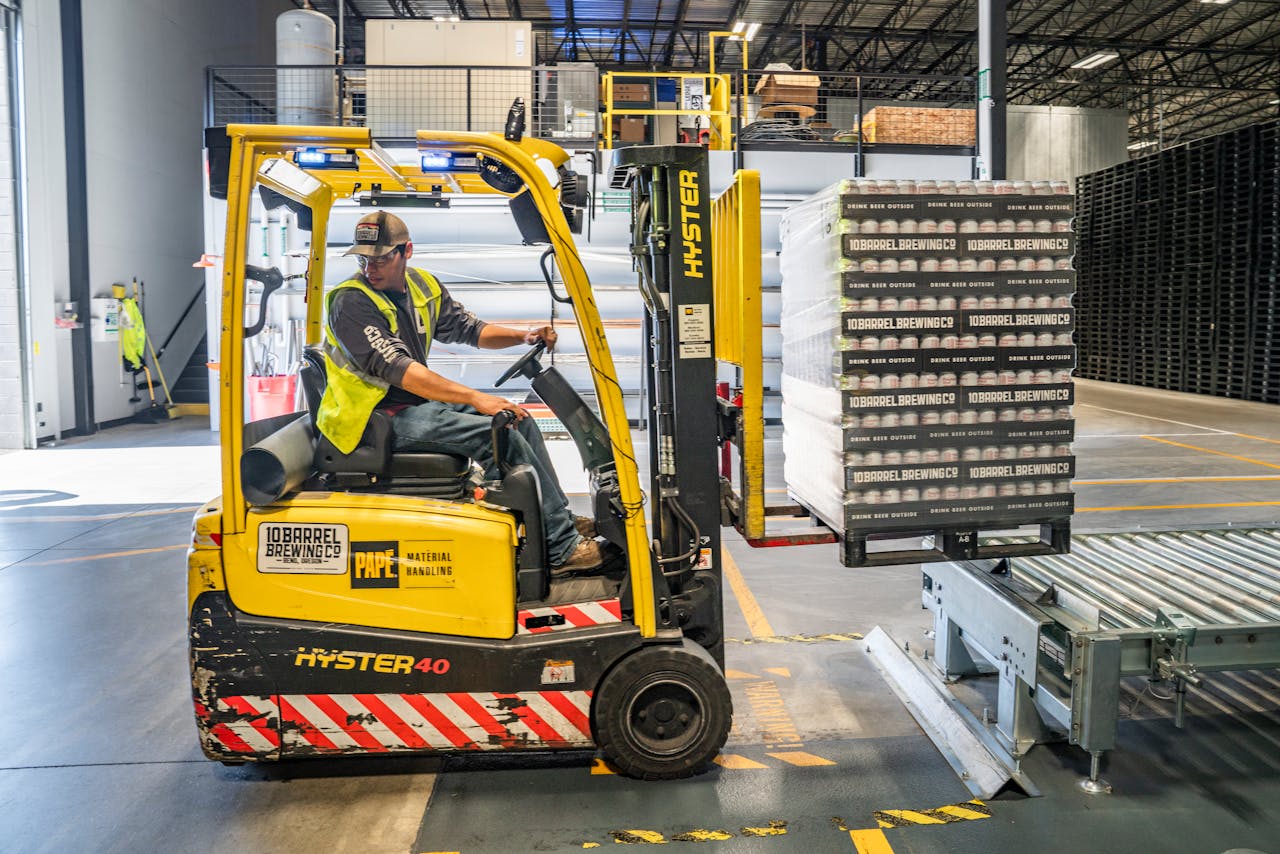
Two identical forklifts sitting on the same warehouse floor can have completely different wear curves depending on how often they run, how heavy their loads are, how aggressively they're driven, and what surface they travel on. Servicing them both on the same 90-day clock means you're almost certainly over-servicing one and quietly under-protecting the other.
AI changes this entirely — not by guessing, but by reading the actual data your machines are already producing.
A Real Scenario: The 90-Day Forklift Problem
A regional logistics company runs a fleet of 24 forklifts across three distribution centers. Every forklift gets a scheduled service every 90 days, without exception. It's what the manufacturer recommends, and nobody has ever questioned it.
The problem is that the forklifts are not all working equally hard:
- Centre A runs two shifts, six days a week — forklifts there are working flat out.
- Centre B is a smaller operation, running one shift, five days a week.
- Centre C handles seasonal overflow — some forklifts barely move for months at a time.
Under the fixed schedule, the lightly used forklifts at Center C get exactly the same service frequency as the heavily worked ones at Center A. The company is spending money it doesn't need to at Center C, while potentially missing real wear signals at Center A between services.
Without AI: The company spends €320 per service, 4 services per year, per forklift — €30,720 per year across the fleet. Three forklifts at Center A develop hydraulic issues between services that weren't caught in time, resulting in €8,400 in unplanned repairs.
With Itenance: The AI monitors actual usage data — hours run, loads lifted, distance covered, hydraulic pressure cycles — and generates service schedules based on real wear, not the calendar. Lightly used forklifts at Center C get serviced every 160–180 days. The hard-working ones at Center A get flagged for inspection at 70 days. Total service spend drops by €4,300 per year. The three hydraulic failures? Caught early. €0 in emergency repairs.
What "Reading the Data" Actually Means
Modern forklifts, vehicles, and industrial machines already generate a constant stream of operational data. Most of it goes completely unread. Itenance connects to that data and turns it into maintenance decisions. Here is what the AI is monitoring:
- Operating hours — not calendar time, but actual running time. A forklift that ran 180 hours last month needs more attention than one that ran 40.
- Load cycles — how many times a machine lifts, presses, cuts, or cycles per shift. High cycle counts accelerate specific types of wear that time-based schedules completely miss.
- Idle vs. active time — a machine that sits idle for three months doesn't need the same oil change as one that ran continuously. The AI adjusts accordingly.
- Fault and error frequency — a single error code is background noise. The same error code appearing twice as often as last month is a trend worth acting on.
- Environmental factors — machines operating in cold storage, dusty environments, or outdoor conditions wear differently than those in a climate-controlled facility. The AI can factor this in.
None of this requires you to build a data science team or install expensive new sensors on every machine. In most cases, the data is already being collected — it just isn't being used.
The Hidden Cost of Over-Servicing
Most maintenance managers focus on the cost of under-servicing — the breakdowns, the emergencies, the downtime. That's the visible cost. But over-servicing has a cost too, and it's rarely discussed.
Every unnecessary service visit involves:
- Labour time for the technician
- Parts replaced before they needed replacing
- Machine downtime during the service window
- Administrative time to schedule, document, and close out the work order
For a mid-sized fleet, these unnecessary visits can add up to €8,000–€15,000 per year in wasted spend. That's money that could go toward better equipment, more staff, or simply staying competitive on margins.
AI-driven scheduling doesn't just protect you from breakdowns — it also stops you from throwing money away on maintenance you didn't need yet.
The Numbers: Fixed Schedule vs. AI-Driven Schedule
| Metric | Fixed Schedule | AI-Driven (Itenance) |
|---|---|---|
| Service frequency (light-use machines) | Every 90 days | Every 160–180 days |
| Service frequency (heavy-use machines) | Every 90 days | Every 60–70 days |
| Annual service cost (24-forklift fleet) | €30,720 | €26,400 |
| Emergency repair incidents per year | 4–6 | 0–1 |
| Estimated annual saving | — | €4,300 – €12,700 |
This Is Not Just for Forklifts
The same principle applies to any fleet or equipment set that is not used uniformly. If you manage a mix of machines with different workloads, Itenance can apply condition-based scheduling to all of them:
- Delivery vans and HGVs — route-heavy vehicles get serviced on actual mileage and load data, not calendar months.
- Compressors and HVAC units — usage-based servicing means you're not changing filters on a lightly loaded unit that doesn't need it yet.
- CNC machines and presses — cycle count data drives lubrication and wear-part replacement schedules far more accurately than the clock.
- Generators and backup power — rarely-run equipment doesn't need full servicing on the same schedule as equipment running daily.
The AI builds a unique usage profile for each individual machine — not each machine type, not each location, but each specific asset. Over time, those profiles become more accurate as the system learns the patterns for your specific operation.
Getting Started: Three Questions to Ask This Week
You don't need to overhaul your entire maintenance programme overnight. Start by asking these three questions about your current fleet or equipment set:
- Are all my machines working at similar intensity? If not, they shouldn't be on the same service schedule.
- When was the last time I adjusted a service interval based on actual usage data? If the answer is "never" or "I'm not sure," you're running on assumptions.
- How much of my maintenance budget last year went to services that found nothing wrong? That number is your over-servicing cost.
If any of those questions make you uncomfortable, that's actually a good sign — it means there's real money and efficiency waiting to be found.
Conclusion: The Calendar Was Never the Right Tool
Fixed maintenance schedules made sense in a world where machines couldn't tell you anything about themselves. That world no longer exists. Your forklifts, vehicles, and production equipment are generating data every minute of every shift — data that, if you're not using it, is simply going to waste.
Itenance reads that data. It builds individual profiles for each asset, adjusts service intervals based on real wear, flags the machines that genuinely need attention, and stops you from spending money on the ones that don't.
Stop guessing. Start knowing.
Ready to put your maintenance schedule on a smarter footing?
Start your free trial at itenance.com and let the data do the work.
Itenance is an AI-first Computerised Maintenance Management System (CMMS) designed for modern industrial operations. From predictive maintenance to automated work orders, it helps maintenance teams do more with less — and keep every asset running at peak performance.
Címkék
Laszlo Habensusz
Szerző
Kapcsolódó bejegyzések
Why Can't I Tell Which Plant Is Really Struggling with Downtime?
Sep 21, 2026 · 6 min read
Why Do Our New Maintenance Technicians Take So Long to Get Up to Speed?
Sep 14, 2026 · 8 min read
Machine Down: Why Do We Always Find Out We're Out of Spares Mid-Repair?
Aug 16, 2026 · 7 min read
Készen áll a karbantartás optimalizálására?
Indítsa el 30 napos ingyenes próbaidőszakát még ma. Nincs szükség hitelkártyára, nincsenek rejtett díjak.