Our Best Injection Moulding Tech Is On Holiday, And The Sumitomo Just Went Down. Now What?
Laszlo Habensusz
Autor
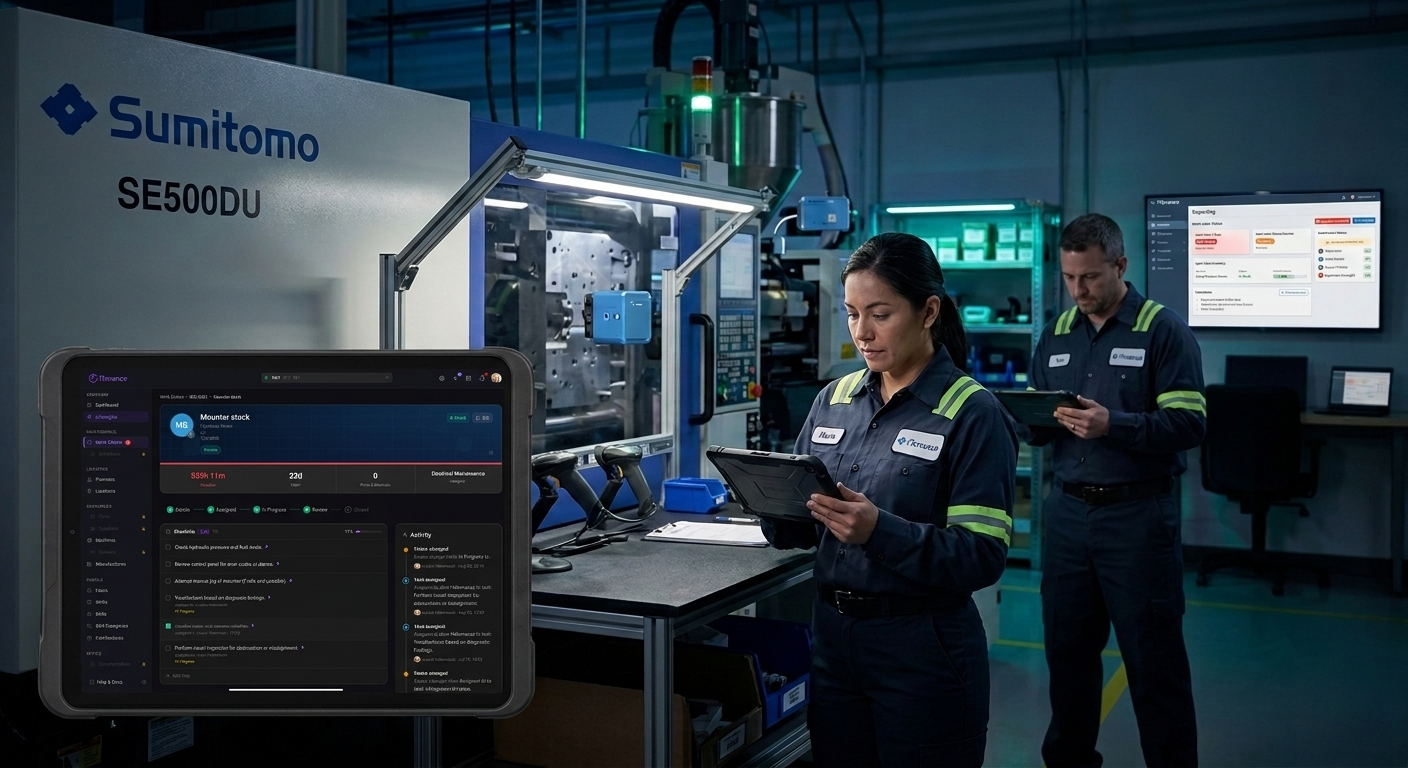
It’s 1:17 AM on Tuesday. You’re two hours into the graveyard shift at your injection moulding shop. The Sumitomo SE500DU, your workhorse for automotive trim, just threw a "Clamp Not Fully Closed" alarm and ground to a halt. The operator tried a reset, no luck. The shift lead, Maria, is staring at a red light that means lost production, missed deadlines, and a very unhappy customer by morning. She calls you, the plant foreman, because this isn't just any breakdown.
This is a Sumitomo SE500DU clamp issue. A specific, intermittent electrical fault that only Dave, your most experienced technician, seems to truly understand. And Dave? He's currently somewhere in the Caribbean, enjoying his first real holiday in five years. You know, the holiday you approved because "nothing ever goes wrong when Dave's away." Except now it has.
The immediate answer to "Now what?" is usually panic. Maria is trying to walk the junior tech, Tom, through what Dave usually does, based on a vague memory of a whiteboard scribble. Tom is good, but he's never seen this particular sensor calibration issue on this specific machine. Every minute the Sumitomo is down means a stack of critical trim pieces isn't being made, backing up the downstream assembly line, and costing thousands.
This situation, where a critical machine's uptime depends entirely on one person's presence and memory, is a common and dangerous reality in many small-to-mid-size manufacturing plants. It’s not just about losing Dave to vacation; what if he gets sick? What if he retires? Your plant's productivity, delivery schedules, and ultimately, its profitability, become hostage to one individual's availability.
Why One-Person Expertise Is A Production Killer
The problem isn't Dave; it's the system that allows such vital, specialized knowledge to reside solely in one person's head. Here's why this "tribal knowledge" approach collapses under pressure:
- Lack of Documented Procedures: When Dave fixes the Sumitomo, he often uses a specific sequence of sensor checks, control board diagnostics, and calibration tweaks that aren't written down anywhere. It's a mental checklist he's refined over years. Without it, other technicians are guessing.
- Reliance on Memory, Not Data: Dave remembers the "weird wobble" the clamp made six months ago, or the "specific hum" that indicated a servo motor was acting up. These observations, critical for diagnosis, are lost to anyone else. There's no machine history tied to specific failure modes or successful repairs.
- Ineffective Training: You might have general injection moulding training, but the specific quirks of the Sumitomo SE500DU's electrical system, especially for intermittent faults, aren't part of any formal program. Cross-training becomes ad-hoc, relying on Dave's free time (which is never enough) and his willingness to share every detail.
- Slow Response Times: When Dave is gone, diagnosis takes longer. Repair attempts are trial-and-error. Parts might be ordered incorrectly or unnecessarily, leading to further delays and wasted inventory.
- High Financial Risk: Every hour of unexpected downtime on a critical machine like the Sumitomo SE500DU is expensive. It's not just the lost production; it's the potential for rush shipping, overtime to catch up, and damage to customer relationships. This financial hit is amplified when the delay is prolonged because the right expertise isn't available.
Your current workarounds probably look familiar: a shared Google Sheet for basic PMs, a whiteboard in the breakroom for urgent jobs, a WhatsApp group for "emergency calls" (which Dave has wisely muted on his holiday), or simply waiting for Dave to return. These might work for a handful of machines or routine tasks. But when your plant scales to fifty machines, or when a complex electrical fault hits your most critical asset, these informal systems don't just hold up – they actively fail, leaving you stranded.
How iTenance Ensures Critical Repairs Happen, Even Without Your Expert
Imagine that same 1:17 AM breakdown on the Sumitomo SE500DU, but this time your plant runs on iTenance. The scenario unfolds very differently:
The Breakdown: From Panic to Procedure
- Operator Reports the Issue: The Sumitomo SE500DU throws its "Clamp Not Fully Closed" alarm. The operator, instead of just calling Maria, pulls out their tablet and uses the iTenance AI assistant. They simply type: "Sumitomo SE500DU, clamp not closing, error code E-312."
- AI Assistant Creates a Smart Work Order: The AI assistant parses the request. It immediately checks the Asset Registry for the Sumitomo SE500DU. It sees the machine's full maintenance and failure history, including past clamp issues and the specific solutions Dave applied. It identifies the error code and automatically creates a detailed Work Order, pre-populating it with the asset, fault description, and a high priority.
- Intelligent Technician Assignment: The AI assistant then consults the People module, which contains a comprehensive technician skills registry. It knows Dave is on holiday, but it identifies Maria and Tom as having "Injection Moulding Electrical Troubleshooting" and "Sumitomo SE500DU Maintenance" skills, and that they are both on shift. It assigns the work order to Maria, with Tom as a secondary contact for support. This eliminates guesswork and ensures qualified personnel are engaged immediately.
- Detailed Repair Guidance at Their Fingertips: Maria receives the work order notification on her tablet. She opens it and sees not just the fault, but also the machine's entire repair history for this specific issue. Dave's previous repair notes, including the specific sequence of diagnostic steps and calibration values, are attached to the asset's history. There's even a reusable checklist from a past Preventive Maintenance task on clamp mechanism checks that she can adapt. This gives her the step-by-step guidance Dave would have provided verbally.
- Real-time Spare Parts Check: The work order suggests potential parts based on past repairs (e.g., a clamp position sensor or a servo driver board). iTenance's Spare Parts Inventory module automatically checks stock levels. If a critical part is low or out, it flags it immediately and can even trigger a reorder to the supplier, ensuring parts are available before Maria even confirms the diagnosis. She doesn't waste time looking for a part that isn't there.
- IoT Sensor Insights (Preventative Layer): While not directly solving *this* breakdown, if the Sumitomo was equipped with IoT sensors monitoring clamp force or servo motor current, iTenance might have detected a subtle degradation trend days or weeks ago. The anomaly detection would have triggered an alert, allowing a planned PM to address the issue *before* it became a critical breakdown. This shifts the paradigm from reactive to proactive.
- Supervisor Oversight and Learning: You, the foreman, get a notification that a high-priority work order has been created and assigned. You can see its status in real-time on your dashboard in the Reporting module. After the repair, the full audit log shows who did what, when, and what parts were used. This data feeds into a Skill-Gap Analysis within the People module, highlighting areas where more cross-training is needed for specific machines or fault types, so you never face this "one-tech-knows-all" problem again.
With iTenance, the "Now what?" isn't a question of panic and delay. It's a sequence of informed actions, guided by documented knowledge and intelligent assignment, ensuring your Sumitomo SE500DU is back online with minimal downtime, regardless of who is on holiday.
Your First Step Towards Uninterrupted Production
You don't need to implement an entire system overnight. Your most practical first step is simple: this week, identify the single most critical machine in your plant – like that Sumitomo SE500DU – and the single most common, complex failure it experiences. Then, sit down with your expert technician (like Dave, if he's back from holiday) and document the step-by-step diagnostic and repair procedure for that specific problem. Even if it's just a digital checklist, get it out of their head and into a shared, accessible format. This immediate action creates your first piece of transferable knowledge, paving the way for a more resilient maintenance operation.
Häufig gestellte Fragen
We have a lot of older machines. Can iTenance still help if they don't have IoT sensors?
Yes, absolutely. While IoT sensors enhance predictive capabilities, iTenance's core value comes from digitizing work orders, asset histories, spare parts management, and technician skills. You can start by documenting manual inspections and repairs, building a rich history for even your oldest equipment.
How long does it take to set up iTenance and get our team using it?
The initial setup can be done quickly, often within an hour, by entering your key assets and a few technicians. Getting your team fully proficient depends on your internal training. iTenance is designed for ease of use, and starting with a few critical machines and pain points allows your team to learn and adapt incrementally.
What if our technicians aren't very tech-savvy?
iTenance is built with a user-friendly interface, designed for shop floor personnel. The AI assistant can parse plain language requests, making it as simple as speaking or typing a message. Training can be focused on specific tasks, like submitting a work request or closing a work order, making adoption straightforward.
We're a small plant. Is iTenance too complex or expensive for us?
iTenance is specifically designed for small-to-mid-size manufacturers and facility teams. Its modular approach means you can start with the features you need most and scale up. The aim is to provide powerful tools without unnecessary complexity, directly addressing common pain points like technician dependency and unplanned downtime.
Schlagwörter
Laszlo Habensusz
Autor
Verwandte Beiträge
Why Can't I Tell Which Plant Is Really Struggling with Downtime?
Sep 21, 2026 · 6 min read
Why Do Our New Maintenance Technicians Take So Long to Get Up to Speed?
Sep 14, 2026 · 8 min read
Machine Down: Why Do We Always Find Out We're Out of Spares Mid-Repair?
Aug 16, 2026 · 7 min read
Bereit, Ihre Wartung zu optimieren?
Starten Sie noch heute Ihre kostenlose 30-Tage-Testversion. Keine Kreditkarte erforderlich, keine versteckten Gebühren.